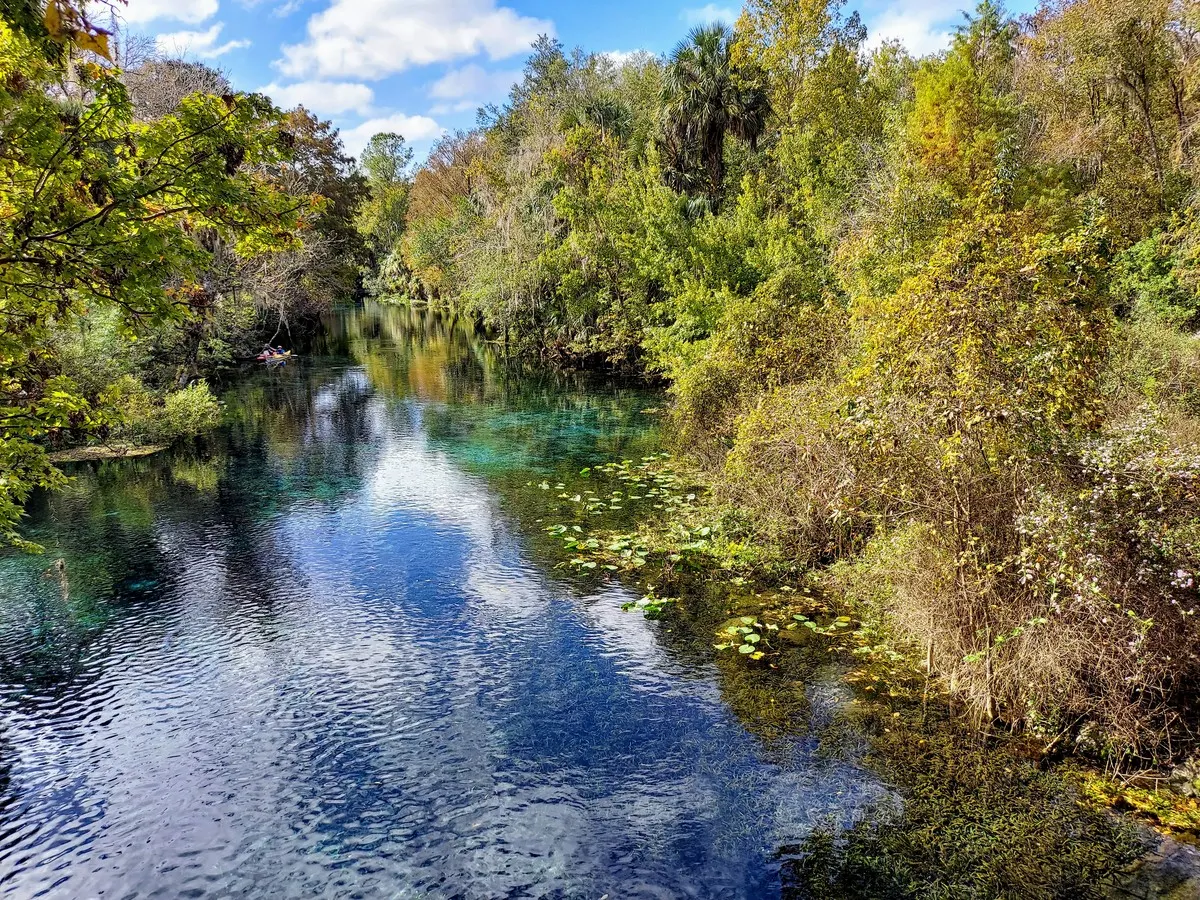
The Silver River at Silver Springs State Park. Photo by P. Hughes, CC BY-SA 4.0, via Wikimedia Commons.
Where Will Ocala's Water Actually Come From? What the Growth, Drought, and Silver Springs Numbers Actually Say
This is a local news news article published on 2026-07-01 covering local Marion County, Florida news. Marion County is the fastest-growing metro in the U.S. for a second straight year, and it's under Phase III Extreme water restrictions in both water management districts at once. Here's what's driving the aquifer strain, what's actually causing Silver Springs' flow decline, and what the Live Local Act does and doesn't change.
Here's what's confirmed on each side of that tension.
How dry it actually is right now
Marion County sits inside two water management districts, and both have escalated to their highest non-emergency shortage tier this year.
The St. Johns River Water Management District (SJRWMD), which covers Ocala and most of the county, moved from a Phase I Moderate shortage (declared February 10) to Phase II Severe (March 2) to Phase III Extreme, effective May 11, 2026, according to the City of Ocala. The Southwest Florida Water Management District (SWFWMD), which covers the City of Dunnellon and The Villages portion of Marion, separately declared its own Phase III Extreme shortage effective April 3, 2026, per WaterMatters.org. Under Phase III, aesthetic water use is prohibited outright, not just limited.
The underlying numbers explain the urgency. SJRWMD's own order, filed for the district in May 2026, cites groundwater levels in Marion County at or below the 10th percentile for more than four consecutive months, and notes the region hit its highest coverage of Extreme Drought (D3) on the U.S. Drought Monitor in years. Central Florida Public Media reported that the district would need 25 to 27 inches of rain over three months just to begin improving those conditions — close to half a normal year's rainfall, compressed into a single season.
Worth flagging: both orders carry a nominal end date of July 1, 2026 — today. Neither district has signaled plans to lift restrictions, and shortage orders are routinely extended when conditions haven't improved, but we'll confirm current status with SJRWMD and SWFWMD directly rather than assume.
What "fines up to $500" actually means
The $500 figure that circulates locally is real, but it applies in two different ways depending on where in the county you are.
In the City of Ocala, water waste falls under general code enforcement, governed by Florida Statute Chapter 162. Per the City's own code enforcement page, a first violation typically gets a compliance window before any fine is imposed; a violation that isn't corrected can draw fines up to $250 per day, and a repeat violation within five years can draw up to $500 per day.
On the SWFWMD side of the county (Dunnellon, The Villages), enforcement is more immediate: as of April 17, 2026, the district eliminated first-offense warnings entirely. Citations are now issued on the spot, with fines running up to $500 per offense.
The growth behind the pressure
The reason these restrictions are landing on a county that's also breaking construction records is straightforward: Marion County has been adding people faster than anywhere else in the country.
Census Bureau estimates released in March 2026 show the Ocala metro area — which is all of Marion County — ranked #1 in the nation for percentage population growth for the second year in a row, reaching 442,660 residents as of July 2025, a 3.4% increase over the prior year, according to WCJB and Ocala-News.com. The county has added more than 66,700 residents since the 2020 Census. Broken down, the most recent year alone added over 14,600 people — roughly one new resident every 36 minutes, day and night, for a full year.
What's actually happening to Silver Springs
"The flow is dropping" is accurate, but the reasons are more specific — and older — than most growth-era framing suggests.
According to SJRWMD's own Minimum Flows and Levels assessment, Silver Springs historically discharged a mean annual flow of 820 cubic feet per second, making it the largest inland spring in Florida by volume and the state's second-largest spring overall. That flow has declined by approximately 32% since the 1930s. The district attributes that decline to three separate causes, not one: a long-term rainfall deficit from the 1970s through roughly 2000 accounts for about 13.3 percentage points of the decline; increased submerged aquatic vegetation downstream in the Silver River, which physically suppresses flow, accounts for about 15.5 points; and regional groundwater pumping accounts for the remaining 3.5 points.
In other words, groundwater withdrawal is a real contributor, but it's the smallest of the three documented causes — rainfall patterns and in-river vegetation growth have done more damage to the flow than pumping has. Nutrient pollution is a separate, and by some measures worse, problem: the Florida Springs Institute's restoration plan puts nitrate-nitrogen concentrations in the spring at more than 3,100% above natural background levels.
What the Live Local Act actually does — and doesn't do
The Live Local Act gets blamed locally for stripping Marion County's ability to slow growth generally. That's an overstatement of what the law actually covers.
Passed in 2023 and expanded twice since, the Act applies specifically to developments where at least 40% of residential units are reserved as affordable or workforce housing (at or below 120% of area median income) for a minimum of 30 years. For qualifying projects on land zoned commercial, industrial, or mixed-use, local governments must administratively approve the project — no rezoning, no public hearing — and density and height are set by whatever's already allowed within a one-mile radius, not by the parcel's own zoning, according to coverage of the law's mechanics and legal analysis from Shutts & Bowen. The latest amendment, House Bill 1389, was approved by the legislature in March 2026 and takes effect today, July 1, 2026, further limiting local governments' ability to reject qualifying projects and extending eligibility to certain publicly owned and religious-institution land, per the Florida Senate's bill summary.
What the law does not do, as far as we could confirm, is exempt qualifying projects from water-supply permitting. Consumptive use permits — the mechanism that actually determines how much groundwater a new development can draw — are issued separately by SJRWMD or SWFWMD and are not zoning matters. So the Live Local Act can fast-track whether a project gets built where it's proposed; it isn't the thing deciding whether the county has water to serve it. Those are two different approval processes, even though they land on the same subdivisions.
What's actually being done about the water supply
The growth-versus-water story isn't only restrictions. SJRWMD lists active projects specifically tied to Silver Springs' recovery on its Marion County page: the Ocala Pine Oaks Wetland Recharge Park, a 33-acre constructed wetland designed to take advanced-treated wastewater and stormwater and recharge it into the Upper Floridan aquifer, with an estimated benefit of 3 to 5 million gallons per day back toward the spring; and the Lake Wyomina Drainage Retention Area retrofit, aimed at cutting nutrient loading reaching the spring by roughly 166 pounds of nitrogen and 38 pounds of phosphorus a year.
Marion County Utilities has also expanded its permitted water withdrawals to match growth before — public-supply consumptive use permits for service areas like Marion Oaks and Quail Meadows were increased specifically to keep pace with projected population, with conditions attached requiring reuse-water studies and conservation reporting. It's an established mechanism, not a new one, even if the current drought is testing it harder than usual.
Where this leaves us
None of this resolves into a single villain. The drought is real and is the dominant near-term driver of the restrictions in effect right now. The growth is real and isn't slowing down. Silver Springs' flow decline predates the current housing boom by decades and has causes that have little to do with any specific rezoning. And the Live Local Act, whatever else it does to local zoning control, isn't the thing standing between Marion County and its water supply — the consumptive use permitting process still is, and it's a separate fight from the one most people are having about it online.
We'll keep tracking the water shortage order status past today's nominal expiration date, along with any updates on the recharge and reuse projects tied to Silver Springs.
Frequently Asked Questions
Why is Marion County under water restrictions?
Both water management districts covering Marion County — SJRWMD and SWFWMD — have declared Phase III Extreme water shortages in 2026 (effective May 11 and April 3, respectively) after groundwater levels fell at or below the 10th percentile for more than four consecutive months and the region hit its highest coverage of Extreme Drought (D3) in years. Under Phase III, aesthetic water use is prohibited outright.
What is causing Silver Springs' flow to decline?
Per SJRWMD's Minimum Flows and Levels assessment, Silver Springs' flow has dropped about 32% since the 1930s from three causes: a long-term rainfall deficit from the 1970s through roughly 2000 (about 13.3 percentage points of the decline), increased submerged aquatic vegetation downstream in the Silver River that physically suppresses flow (about 15.5 points), and regional groundwater pumping (the remaining 3.5 points). Pumping is real, but it's the smallest of the three documented causes.
Does the Live Local Act affect water supply approval?
No. The Live Local Act fast-tracks zoning approval for qualifying affordable-housing developments, but it does not exempt those projects from water-supply permitting. Consumptive use permits, which determine how much groundwater a development can draw, are issued separately by SJRWMD or SWFWMD and are not part of the zoning process the Act changes.
What is the fine for violating watering restrictions in Ocala?
In the City of Ocala, a first violation typically gets a compliance window before any fine, an uncorrected violation can draw fines up to $250 per day, and a repeat violation within five years can draw up to $500 per day. In the SWFWMD portion of Marion County (Dunnellon, The Villages), the district eliminated first-offense warnings as of April 17, 2026 — citations are issued immediately, with fines up to $500 per offense.
Sources
- City of Ocala. "Irrigation Schedule." ocalafl.gov
- WaterMatters.org (SWFWMD). "District Declares Modified Phase III Water Shortage." swfwmd.state.fl.us
- Central Florida Public Media. "Extreme water shortages cover Lake, Marion, Polk, Sumter." cfpublic.org
- City of Ocala. "Code Enforcement." ocalafl.gov
- WCJB. "Ocala metro ranks No. 1 in growth for second year, US Census Bureau says." wcjb.com
- Ocala-News.com. "Ocala still ranked #1 fastest-growing city in the country by Census Bureau." ocala-news.com
- SJRWMD. "Minimum Flows and Levels: Silver Springs." sjrwmd.com
- Florida Springs Institute. "Silver Springs Restoration Plan — Executive Summary." floridaspringsinstitute.org
- Best Lawyers. "Florida Rewrites Rules on Housing: Live Local Act." bestlawyers.com
- Shutts & Bowen. "Florida's Live Local Act." shutts.com
- Florida Senate. "HB 1389 Bill Summary (2026)." flsenate.gov
- SJRWMD. "Marion County." sjrwmd.com
Related Ocala Guides
More context and planning resources from Only In Ocala.