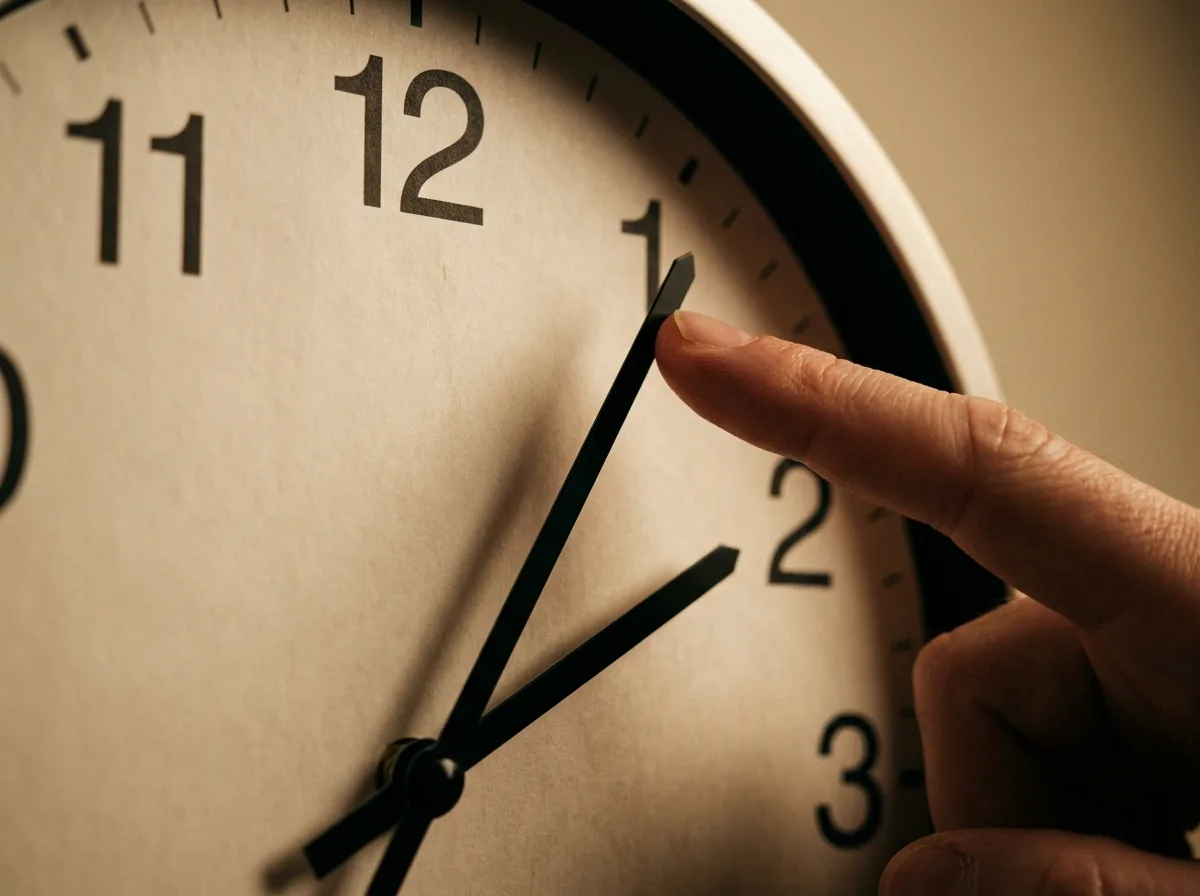
AI-generated illustration of clock hands being turned back.
Daylight Saving Time Ends Sunday, Nov. 1, 2026: Ocala Falls Back an Hour at 2 a.m.
This is a local news news article published on 2026-10-20 covering local Marion County, Florida news. Daylight saving time ends at 2 a.m. Sunday, Nov. 1, 2026, when clocks in Ocala and Marion County fall back to 1 a.m. Florida's 2018 Sunshine Protection Act cannot take effect unless Congress changes federal law, and it has not.
Florida still changes its clocks. The state passed a law in 2018 to stay on daylight saving time all year, but that law depends on an act of Congress that has not happened.
AI-generated illustration.
At a Glance
- When: Sunday, Nov. 1, 2026, at 2 a.m. EDT
- What happens: clocks go back one hour to 1 a.m. EST
- Where: all of Ocala and Marion County, which are in the Eastern time zone
- Sunset in Ocala: 6:43 p.m. on Saturday, Oct. 31; 5:42 p.m. on Sunday, Nov. 1 (NOAA)
- Next change: daylight saving time starts again at 2 a.m. Sunday, March 14, 2027
- Year-round DST in Florida: approved by the Legislature in 2018 but can take effect only if Congress changes federal law
What Federal Law Says
The dates are set by 15 U.S.C. 260a. The law says standard time is advanced one hour from 2 a.m. on the second Sunday of March to 2 a.m. on the first Sunday of November. According to NIST, the current dates were set by the Energy Policy Act of 2005 and took effect in 2007. NIST says daylight saving time now covers 238 days, or about 65% of the year.
The federal law lets a state opt out in only one direction. A state that lies entirely in one time zone can exempt itself and stay on standard time all year. The law does not allow a state to stay on daylight saving time all year. It also says Congress intends to override any state law with different changeover dates. NIST notes that daylight saving time and time zones are regulated by the U.S. Department of Transportation.
Florida's Sunshine Protection Act
In 2018 the Florida Legislature passed HB 1013, the "Sunshine Protection Act," which became Chapter 2018-99, Laws of Florida, effective July 1, 2018. The Senate companion, SB 858, was laid on the table after the House bill passed.
The law is conditional. Its key sentence says that if Congress amends 15 U.S.C. 260a "to authorize states to observe daylight saving time year-round," the Legislature intends daylight saving time to be the year-round standard time for all of Florida. Until Congress makes that change, Florida follows the federal schedule and changes its clocks twice a year like most of the country.
The federal statute posted by Cornell's Legal Information Institute still has no year-round daylight saving option. Its most recent listed amendment is the 2005 change that set today's dates.
Daylight in Ocala Before and After
The change moves an hour of daylight from the evening to the morning. In Ocala, NOAA's solar calculator tables (calculated for downtown Ocala, 29.187 N, 82.140 W) show:
- Saturday, Oct. 31 (EDT): sunrise 7:41 a.m., sunset 6:43 p.m.
- Sunday, Nov. 1 (EST): sunrise 6:41 a.m., sunset 5:42 p.m.
That means sunset comes before 6 p.m. on the first evening of standard time. Trick-or-treating on Halloween night, Saturday, Oct. 31, still falls under daylight saving time, with sunset at 6:43 p.m. Neighborhood events are listed in our trick-or-treat guide and Halloween in Ocala roundup.
Phones, Computers and Other Clocks
NIST says its time services broadcast Coordinated Universal Time (UTC), and the adjustment for daylight saving time comes from a device's operating system. Computers and phones with current software updates change on their own.
For what the cooler months bring, see our guides to Ocala weather and fall activities in Ocala.
Sources: 15 U.S.C. 260a (Cornell Legal Information Institute); NIST Time and Frequency Division, "Daylight Saving Time (DST)"; Florida Senate bill pages for 2018 HB 1013 (Ch. 2018-99) and SB 858, and the enrolled text of HB 1013; NOAA Global Monitoring Laboratory solar calculator sunrise and sunset tables for 2026 at 29.187 N, 82.140 W. Checked Oct. 20, 2026.
Related Ocala Guides
More context and planning resources from Only In Ocala.