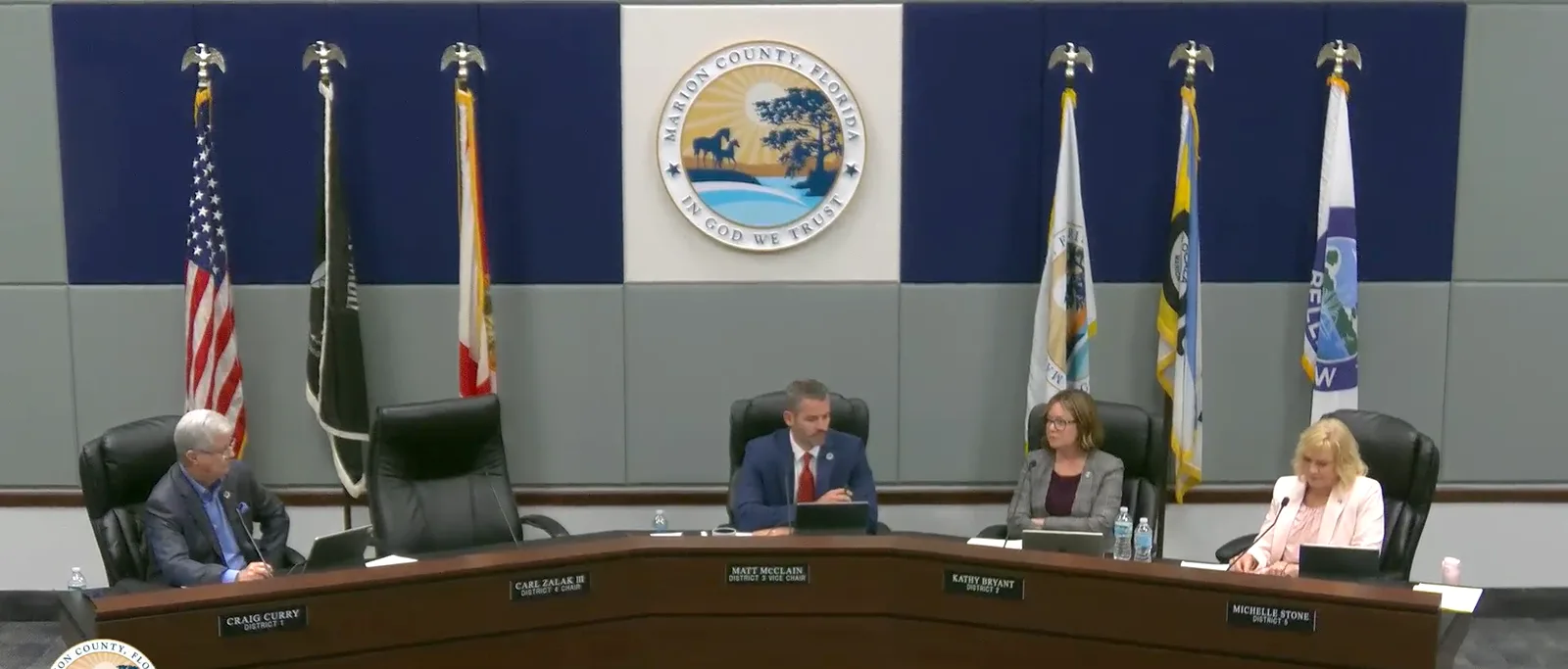
Commissioners Craig Curry, Matt McClain (presiding), Kathy Bryant and Michelle Stone hear the Capozzoli farm request on Oct. 6, 2026. Chairman Carl Zalak III's seat is empty. Still from Marion County's meeting video.
'Our Hands Are Being Tied': Marion County Approves Its First Agricultural Enclave Under New State Law
This is a government news article published on 2026-10-10 covering local Marion County, Florida news. In December, Marion County commissioners said no to 71 homes on a horse farm off SW 80th Street. On Oct. 6 they said yes, 4-0, because a new state law gave them little choice. Commissioners said the state keeps taking decisions away from the people closest to them.
Commissioners hear the Capozzoli farm request on Oct. 6, 2026. Still from the county's meeting video.
The farm belongs to Linda Capozzoli, who has raised and trained horses on 19.75 acres at 7317 and 7325 SW 80th Street for more than 10 years. It sits about half a mile west of State Road 200 in southwest Marion County. Pastures and homes on big lots surround it on three sides. On the fourth side, to the west, the county has already approved a new subdivision called Westwood Trails, at up to four homes per acre. Last fall Capozzoli asked to build at that same density. County planners recommended approval, and so did the Planning and Zoning Commission. On Dec. 16, 2025, commissioners turned her down. Their biggest worry was traffic where SW 80th Street meets State Road 200.
Capozzoli did not let it go. In January she filed a request for state-ordered mediation and a lawsuit against the county. The two sides settled. In the settlement, the county agreed that its public notice for the December hearing "did not comply with applicable law." It let her apply again right away without paying new fees, but promised nothing about the outcome.
Then Tallahassee changed the rules. On July 1, a new state law, Senate Bill 686, took effect. It was sponsored by state Sen. Stan McClain, whose district includes Marion County, and it passed the Senate 34-2 and the House 90-20, according to the Florida Senate. The law gives owners of farms that are mostly surrounded by growth, called "agricultural enclaves," a shortcut. If the farm qualifies, the owner can build homes at the same density as the land next door, and the county has to treat the project as allowed no matter what its growth plan or zoning map says. The county gets 90 days to decide, or the farm is approved automatically. Once it is approved, there is no second public hearing on the homes, and the county has to finish reviewing the plans within 180 days. The new law also made it easier to qualify, and it expires on Jan. 1, 2028, unless lawmakers renew it, according to the Senate's bill analysis.
In August, Capozzoli's attorney, Christopher Roper, applied under the new law. County staff and County Attorney Matthew Minter both found that the farm met every requirement. Even the farmhouse and the small employee home on the property did not count against it, Minter wrote in a memo to the board, because state law does not treat a home on a farm as development.
"We cannot disagree"
At the hearing, Minter reminded commissioners that counties are political subdivisions of the state. "County government is subject to that statute and we cannot disagree with what the state legislature has said," he said. "So that's why we're here today." Curry asked whether he could still vote no because of the intersection. Minter said the new law "does not address consideration of those impacts." If the board said no anyway, Capozzoli could go straight to court, and Minter said he could not rule out a claim for money damages under Florida's property-rights law. Roper had brought a court reporter in case of an appeal.
That did not sit well on the dais. Commissioner Kathy Bryant told Roper the board was only talking about lawsuits because he had threatened one. "Our hands are being tied behind our backs because of what the state of Florida has done," she said. Later she said, "Decisions like this should be left up to the local government who are going to have to deal with them," and added that the board was being pushed to approve homes "when we don't even know where the funding is going to come from to fix the infrastructure." Commissioner Michelle Stone put it in five words: "We can't break the law." Curry said he was "not at all happy with the state of Florida continuing to dilute our home rule," but that he could not "spend people's tax money knowing that we're going to lose this suit."
Vice Chairman Matt McClain, who ran the meeting while Chairman Carl Zalak III was absent, agreed the farm "does meet the legal definition." Curry made the motion, Stone seconded it, and it passed 4-0. Roper then withdrew the land-use change and rezoning requests, which the farm no longer needed.
Roper told the board the farm was a clear fit for the law, a horse farm squeezed between State Road 200 and On Top of the World. "It's a pretty cut and dry straightforward agricultural enclave case," he said. Capozzoli has offered to pay her share of road improvements. Several commissioners said they understood why a longtime owner surrounded by new subdivisions would want to sell.
Neighbors were less understanding. Eight people spoke, and most talked about traffic. Cheryl McLean of Hibiscus Park said drivers heading north from SW 80th Street have to turn right onto State Road 200 and make a U-turn, and that a 2018 state traffic study had found a signal was justified there. "I feel like we're being intimidated," she said. "The county is being intimidated by this project." Kelly Douglas, who lives on SW 75th Avenue, said the order of things was backward. "My concern is that we are approving homes first and asking whether the roads can handle them afterwards," she said. Steve McAllister, who lives on SW 72nd Court, warned that once one farm converts, the next one will be easier.
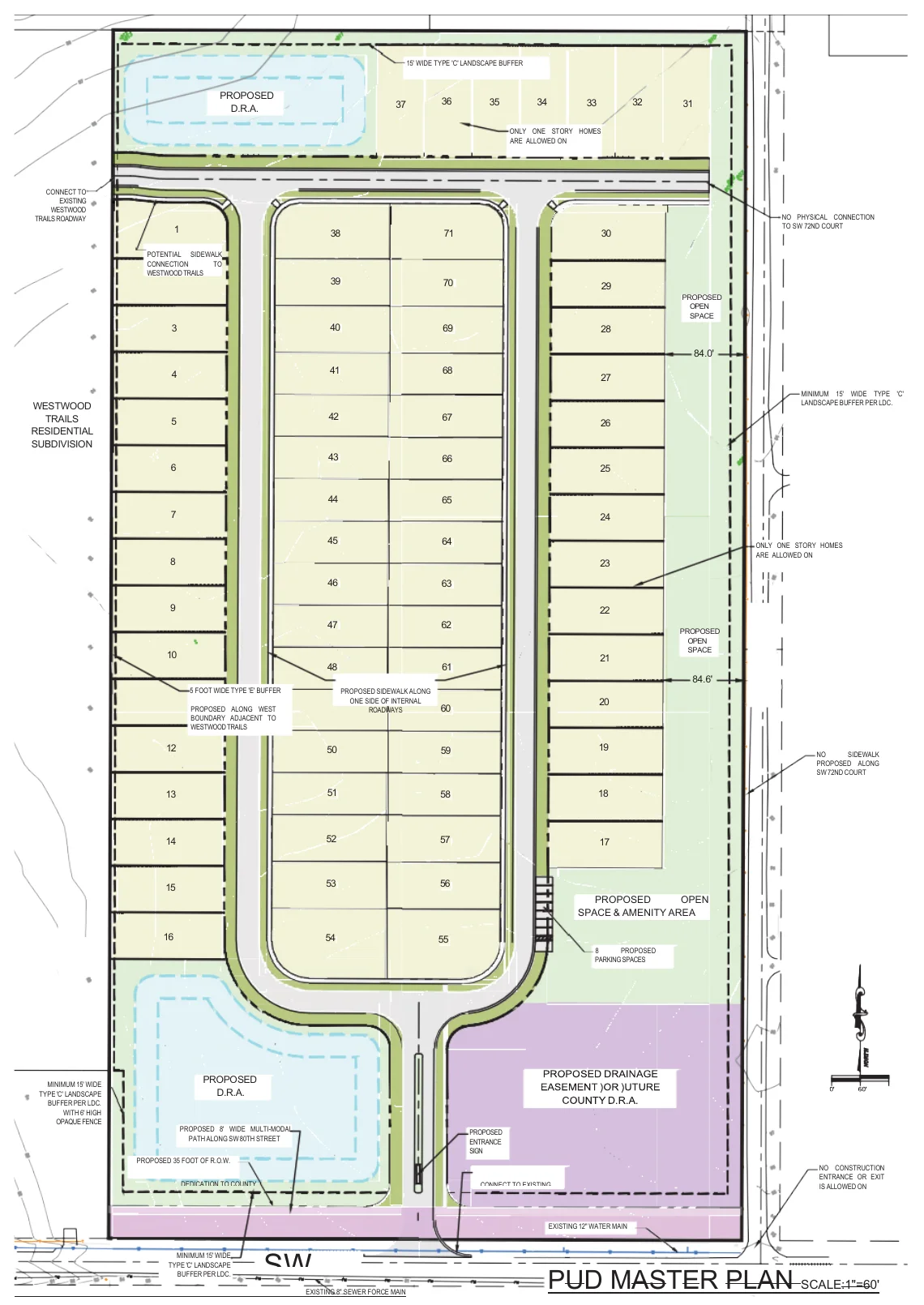
The "Capozzoli Hills" site plan filed with the county. North is at the top; SW 80th Street runs along the bottom.
The site plan Capozzoli filed with the county, called Capozzoli Hills, shows what the 71 homes could look like. One entrance comes off SW 80th Street and feeds a long loop road. A street along the north end connects west into Westwood Trails. There is no road onto SW 72nd Court, and homes near the north and east edges are limited to one story. Stormwater ponds sit in the northwest and southwest corners. The final plans will go through county staff review, not another public hearing, and could still change.
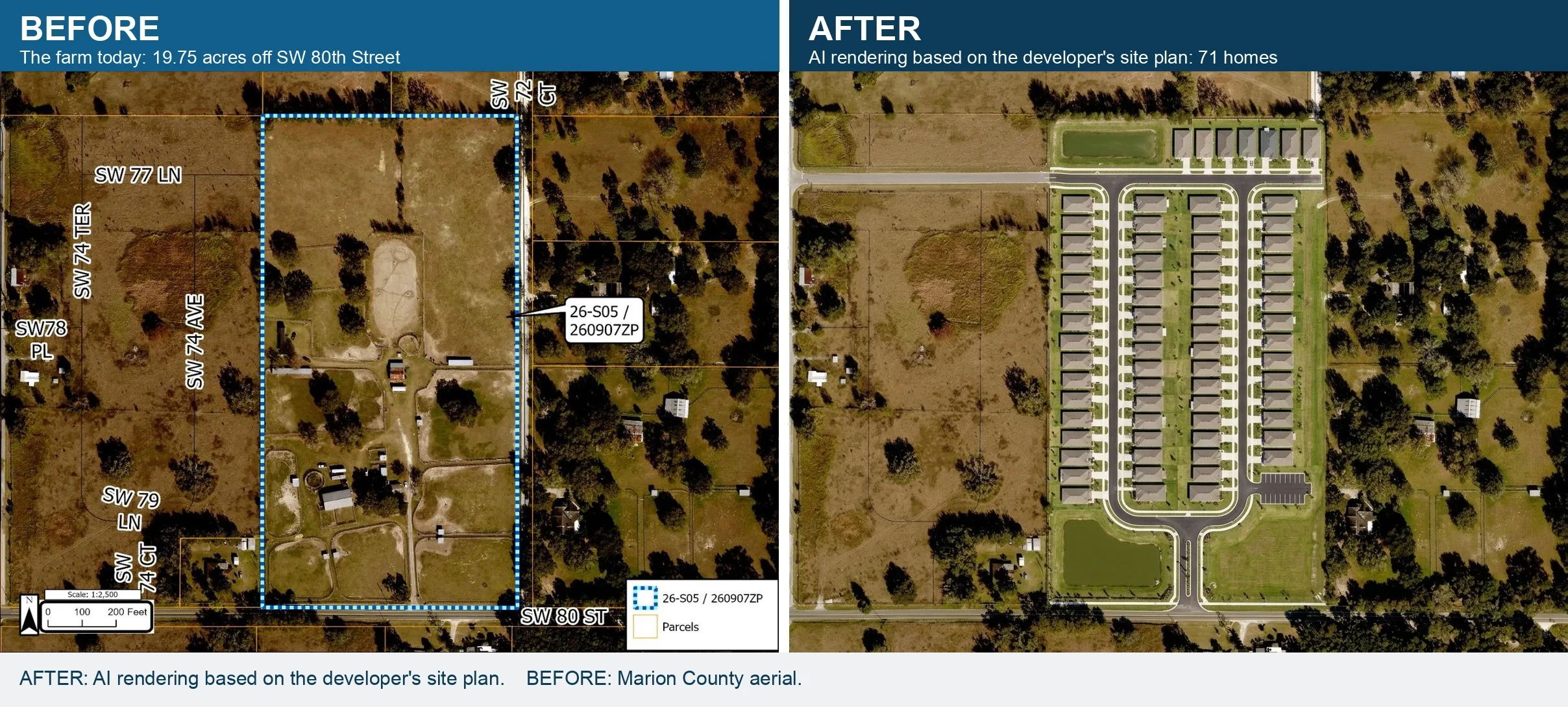
Left: Marion County aerial of the farm today. Right: AI rendering based on the developer's site plan, not a photo.
Not just Tallahassee
Marion County is not the only local government watching decisions move further away. In May 2025, the U.S. House passed its version of the "One Big Beautiful Bill" by a single vote, 215-214. Tucked inside was a 10-year ban: no state, county or city could enforce any law "limiting, restricting, or otherwise regulating" artificial intelligence, according to the bill as passed by the House. Local rules that made zoning and permitting easier for AI would still be allowed. Rules that slowed it down would not. U.S. Rep. Kat Cammack, who represents most of Marion County, and U.S. Rep. Byron Donalds of Southwest Florida both voted yes, according to the House Clerk's roll call. The Senate stripped the ban out 99-1 on July 1, 2025, before the bill became law.
The two bills came from different capitals and dealt with different things, but they pushed in the same direction: away from the five commissioners Marion County voters elect, can call by name and can face at a Tuesday meeting on SE 25th Avenue. Each time a higher level of government decides it knows better, the people who live next to the result have less say in it. Curry called the Capozzoli farm "our first one." Nothing in the state law says it has to be the last.
The Marion County Commission meets the first and third Tuesday of each month at 9 a.m. at the McPherson Governmental Campus, 601 SE 25th Ave., Ocala. Agendas are posted on the county's meeting calendar, and more is on our Marion County government page.
Sources: Marion County Legistar files 2026-24476, 2026-24269 and 2026-24270 (staff reports, County Attorney memo, settlement agreement, site plan and ordinance); county video of the Oct. 6, 2026, commission meeting; Florida Senate, SB 686 (2026) bill history, enrolled text and Rules Committee analysis; U.S. House Clerk, Roll Call 145 (May 22, 2025); H.R. 1 as passed by the House, Sec. 43201. Checked Oct. 10, 2026.
Related Ocala Guides
More context and planning resources from Only In Ocala.