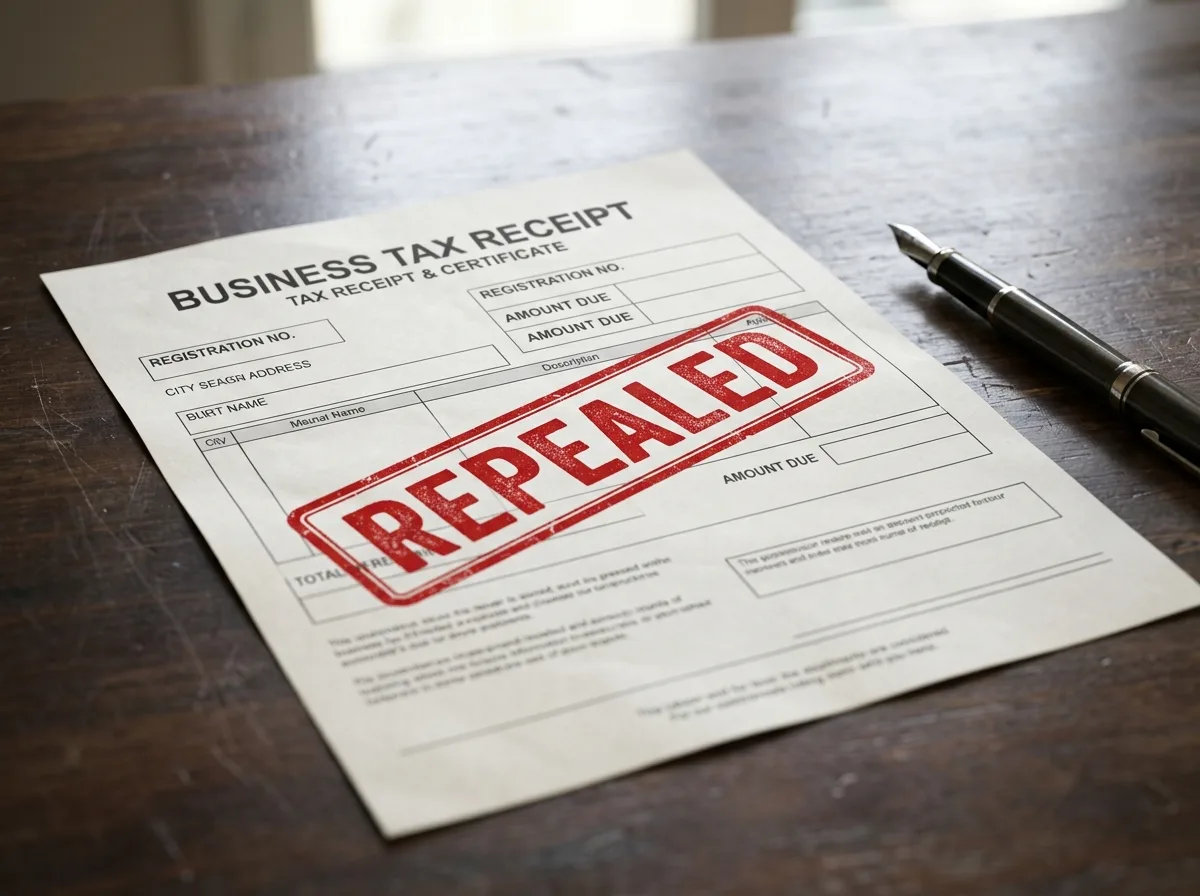
AI-generated illustration, not an actual City of Ocala document. The repeal is not final until the Oct. 20 vote.
Ocala Moves to Repeal Its Business Tax Receipt: Final Vote Oct. 20, With Refunds for 2026-27
This is a government news article published on 2026-10-09 covering local Marion County, Florida news. Ocala City Council introduced Ordinance 2027-1 on Oct. 6 to repeal the city's local business tax, known as the business tax receipt (BTR). The final vote is scheduled for Oct. 20. Staff also asked to refund businesses that already paid for 2026-27.
AI-generated illustration, not an actual City of Ocala document. The repeal is not final until the Oct. 20 vote.
The second and final reading is scheduled for Oct. 20, 2026. Under the ordinance as written, the repeal takes effect immediately once the mayor approves it or it becomes law without that approval.
What the Repeal Does
- Ends the city business tax for everyone. The ordinance abolishes both the business tax receipt (for commercial businesses) and the business tax certificate (for professions and occupations) "in their entirety" for all businesses operating within city limits.
- Refunds for this year. Staff asked council to approve refunds for businesses that already paid for the 2026-27 year, according to the staff report.
- Other rules still apply. The ordinance states that the repeal does not exempt any business from building codes, zoning or fire inspections, which stay enforceable through the Growth Management Department, the Building Division and Ocala Fire Rescue.
Why the City Wants Out
The staff report from the city's Growth Management Department lays out the case:
- A 1995 fee schedule. The current rates were adopted by Ordinance No. 2553 in September 1995 and have not been comprehensively updated in more than 30 years. Staff say the old categories no longer fit the businesses operating in 2026.
- Falling revenue, rising cost. Revenue dropped from $457,000 in 2022 to $374,000 in 2025, while the staff cost of running the program rose from $64,000 to $69,000. Staff estimate the full cost, counting facilities, software, legal and administration, is likely higher than $100,000 a year, before any enforcement.
- Many businesses don't have one. The city has 4,462 active receipts. Based on utility accounts and other city data, staff estimate the number of businesses actually operating is "possibly double or more."
- State limits. Florida law (Chapter 205) caps how much a city can raise these taxes and requires an equity study commission before reclassifying businesses. A repeal needs only a majority vote.
- Statewide momentum. In the 2026 session, House Bill 103 proposed repealing Chapter 205 altogether; it passed the House 82-26 but did not get out of the Senate Appropriations Committee, the report says.
The ordinance lists other Florida governments that have already dropped their programs, including Leesburg (2020), Volusia County (2024), Sarasota County (2024) and Clermont (2025), according to a comparison prepared by city staff.
What It Costs the City
The adopted Fiscal Year 2026-27 budget counts on $426,000 in General Fund revenue from the tax. If council approves the repeal, the Budget Office will cut that revenue line and reduce the General Fund's reserve for contingencies, the staff report says.
Marion County Dropped Its License in 2006
Businesses outside city limits already pay no local business tax. Marion County commissioners voted 5-0 on Aug. 1, 2006, to repeal the county's occupational license ordinance, effective Oct. 1, 2006, according to the Marion County Tax Collector. That page notes that Belleview and Dunnellon set their own requirements, so businesses in those cities should check with them. State professional licenses and contractor licensing are not affected by either repeal.
What Business Owners Should Do Now
Until council votes on Oct. 20, the current code is still in effect. Anyone starting a business in Ocala can follow the rest of the process in our guide to forming an LLC in Ocala, and our accountant and tax preparation guides list local firms. For Chamber programs for small businesses, see the events calendar, which carries 1 Million Cups and Business After Hours. We will update this story after the Oct. 20 vote.
Sources: City of Ocala Legistar file ORD-2027-1 (staff report, ordinance and "Other Jurisdiction Actions" attachment); City Council synopsis of Oct. 6, 2026; City Council agenda for Oct. 20, 2026; Marion County Tax Collector, Business Tax License page. Checked Oct. 9, 2026.
Related Ocala Guides
More context and planning resources from Only In Ocala.